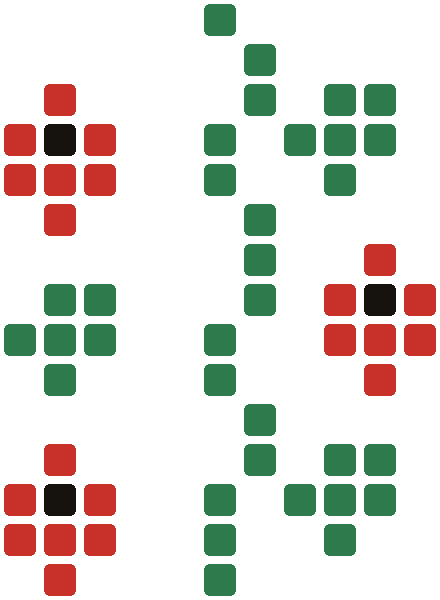
Ruzha (rose)
Ruzha, or rozha, is an eight-petaled flower rosette with no clear botanical features; in folk speech the word meant both the hollyhock and the rose.
Ruzha, or rozha, is one of the most widespread flower motifs in Ukrainian ornament: an eight-petaled rosette that is embroidered, woven and drawn on pysanky (wax-resist Easter eggs). Despite the usual translation, it is not necessarily a rose. In folk speech rozha meant both the rose and the hollyhock, and in ornament it is more of a generalized “flower.” In folklore it is tied to beauty, merriment and maidenhood.
Meaning and interpretations
What the word means
The 19th-century historian Mykola Kostomarov, in an 1872 study of song symbolism, observed that where real roses did not grow, the hollyhock took their place (he gives it the Latin name Rosa althea). Pysanka researchers likewise stress that the ruzha is first of all a hollyhock, not a rose. Art historian Mykhailo Selivachov describes the rozha as a mostly eight-petaled flower without distinct botanical features.
The Volhynian researcher Nataliia Bendiuk adds that the most common “flowers” in the decorative art of Volhynia and other regions are six- and eight-petaled rosettes that resemble stars. Weaving and basketry, she notes, geometrize the flower into diamonds and triangles, while painting and pysanky make it more dynamic.
What it symbolizes
In songs. According to Kostomarov, the rose in folk poetry stands for beauty and pleasure — the finest flower in the world. He retells a song that asks which plant is best in the world — periwinkle, cornflower or the red rose — and the answer favors the rose. A girl boasting of her beauty compares herself to a “full rose.” In another song a girl asks the rain to water her “maiden” flowers: rose, periwinkle, cornflower and mint. At the same time, Kostomarov notes, some songs compare a young Cossack to a blooming rose, and the rose and the kalyna (guelder rose) appear as a male and female pair. Following Kostomarov, Bendiuk sums up: the rose meant beauty, tenderness and gaiety.
In ornament. Art historians Oleksandr Naiden and Selivachov write that a rosette of eight diamonds — the “full rose” — symbolizes maidenhood. Pysanka researchers, among them Marusia Chaika, read a large rose on the side of an egg as a solar sign; small roses scattered across the surface, by the same reading, may simply be stars. Both are scholars’ interpretations.
In a Christian context. Selivachov cites a legend in which St. Anne conceived the Virgin Mary from the scent of a rose, and the Mother of God was called the “Holy Rose.” So for many makers the flower may also have had a religious tint.
These meanings are not mutually exclusive. The same rosette could be a “flower for beauty,” the sun, and a wish for a girl’s happiness, depending on the object, the region and the person.
Where it appears
Embroidery. Art historian Tetiana Kara-Vasylieva lists roses among the characteristic motifs of Polissia in northern Ukraine, alongside hops, periwinkle and bindweed. She also mentions a stitch from the Horodok area that alternates rosettes and chains, and the spread of naturalistic cross-stitched flowers in red and black.
Weaving. Rosettes are among the main motifs of the woven towels of Krolevets. Bendiuk writes that in Volhynian weaving, embroidery and egg decorating the motif is more often called an “eight-pointed star,” a “windmill” or “stars.”
Pysanky. The rose is one of the most common pysanka motifs. Known examples include the “green rose” from the village of Hubske in the Poltava region and examples from the Kholm region.
The motif is found across Ukraine, so we do not list a specific region.
How it is depicted
The rose and the eight-pointed star are often almost identical: makers called the same figure now a star, now a flower. Pysanka researchers suggest a practical distinction — a large rose is built on a circle and looks more like a flower, while small eight-pointed stars in bands are built on a square.
Folk names for the variants used in Galician Volhynia (around Sokal, Belz and Brody) were recorded by Iryna Hurhula, who studied pysanky from the collection of the National Museum in Lviv in 1929:
| Name | Probable appearance |
|---|---|
| Starry rose | a flower with pointed petals that shades into a star |
| Full rose | a flower with ornamental or colored filling inside |
| Empty rose | an outline only, with no inner pattern |
The descriptions in the right-hand column are Bendiuk’s suggestions, not explanations recorded from the makers.
Besides geometric rosettes there are naturalistic roses with rounded petals, buds and leaves, typical above all of cross-stitch from the late 19th and 20th centuries. Our illustration shows a geometric “full” rose: eight red petals with black hearts around a black center.
Colors
There is no fixed “correct” color for the rose. In the songs Kostomarov retells, the red rose is the most frequent, and red is also the most common color for it in embroidery, often with a black heart or outline. Yet there is the “green rose” of the Poltava region, and on pysanky roses are drawn in yellow, red, black or white, depending on the local palette. So when choosing colors, look to the tradition of a specific region rather than to generic “color meaning” charts.
Myths and modern interpretations
“The ruzha is always a rose, the symbol of love.” Linking the rose to love has support in folklore, but botanically it is often a hollyhock, and in ornament simply a flower. Reading every rosette as a “rose of love” is an oversimplification.
“The star of Ruzha,” “Alatyr,” “fern flower.” Some modern websites and amulet sellers give the eight-petaled rosette “ancient” names and attribute magical power to it. No such names for the rose appear in ethnographic records. These are modern esoteric interpretations.
“The rose is for girls only.” A link with maidenhood is indeed documented for the “full rose.” But we found no evidence that the motif was strictly banned from men’s clothing.
The ruzha shows better than most motifs how folk speech, folklore and ornament intertwine: a geometric figure took the name of a flower, and its meaning rested on the song symbolism of beauty. For more motifs, browse our symbol encyclopedia or the guide to Ukrainian embroidery symbols.
FAQ
Is the ruzha a rose?
Not necessarily. In folk speech “rozha” meant both the rose and the hollyhock, and in ornament it is usually a generalized eight-petaled flower without botanical detail.
What does the ruzha symbolize?
In folklore the rozha stands for beauty and merriment, and art historians link the “full rose” of eight diamonds with maidenhood. Pysanka researchers often read a large rose as a solar sign.
What is the difference between a “full” and an “empty” rose?
These names, used in Galician Volhynia, were recorded back in 1929 by the researcher Iryna Hurhula. Most likely a full rose has a filled center and an empty one is an outline only, but that is a modern researcher’s guess, not the makers’ explanation.
Can the ruzha be embroidered on a man’s shirt?
We found no evidence of strict prohibitions. In folklore the rose is often linked to a girl’s beauty, but Kostomarov also cites songs that compare a young Cossack to a blooming rose. Eight-petaled rosettes appear on all kinds of objects.