Berehynia
Berehynia is today’s name for the female figure with raised arms on ritual towels; many scholars see the “ancient guardian goddess Berehynia” as a late 20th-century construct.
Today, Berehynia is most often the name given to a stylized female figure with raised or outstretched arms, embroidered on rushnyky (ritual towels). The motif itself is genuinely found in folk embroidery and weaving. But the idea of Berehynia as an ancient Ukrainian goddess who guards the home and the family is regarded by many scholars as a construct of the late 20th century. This page keeps those two things apart.
Meaning and interpretations
What the old texts say
The word berehyni (plural) occurs in several Old Rus’ sermons against paganism, such as the “Sermon on How the Pagans Worshipped Idols.” These mentions are local insertions into translations from Greek. The berehyni appear only in the plural, alongside vampires and other beings to whom people “made offerings.” What they looked like or what they “did” is unknown.
The origin of the word is debated. Some 19th-century scholars derived it from bereh (riverbank) and linked the berehyni to rusalky (water spirits). Others compared it with perehynia, a participant in a harvest rite, and the historian Boris Rybakov proposed his own, also disputed, etymology. The reading “the one who protects” (from berehty, to protect) is often treated as folk etymology; Mykhailo Selivachov traces how the word’s sense drifted from perehynia through “riverbank” to the verb “to protect.”
Where the “guardian goddess” came from
Berehynia as an ancient goddess protecting home, family and nation became popular in the late 1980s, during the wave of national revival. Works of the same name by the writer Vasyl Ruban and the ethnographer Vasyl Skurativskyi played a big part; Skurativskyi’s book Berehynia came out in 1987. It then spread to textbooks, the press and the names of organizations.
As early as 2005 the historian Oksana Kis argued that the image is a modern construction created mostly by male authors, and that it ties women to the role of mother and keeper of the hearth. Other scholars have criticized the “Berehynia myth” too. Selivachov calls it a late mythologem that came into fashion thanks to the word’s pleasant sound. Overall, most academic researchers see the “ancient goddess Berehynia” as a product of romantic literary invention, not a reconstruction.
And the embroidery?
Here things are more complicated. Anthropomorphic — human-like — motifs certainly exist in Ukrainian ornament. Art historian Tetiana Kara-Vasylieva mentions female figures with birds in the embroidery of western Podillia, and lists “berehynia” among old motifs next to the tree of life and solar signs. According to Selivachov, though, art-historical writing uses this name only from the late 1960s; the classic studies of folk ornament from the late 19th and early 20th centuries do not have it. That alone shows how firmly the new name has settled even into specialist texts.
Human-like figures also have a long archaeological history: scholars note zoomorphic and anthropomorphic elements as early as the ornament of the Trypillia culture. Here opinions divide. Selivachov, following Marija Gimbutas and Rybakov, considers the link between female figures in folk ornament and a “Great Neolithic Goddess” beyond doubt. Yet several thousand years separate Trypillian pottery from 19th-century embroidery, with almost no evidence in between, so many treat that continuity as a hypothesis: similar shapes do not prove shared meaning. And even Selivachov, while accepting the motif’s ancient roots, insists that the name “berehynia” is recent.
Naiden and Selivachov are cautious elsewhere too: they note that a diamond, among other possible meanings, might have been read as a female deity, but they stress how many meanings such signs can carry.
Field records give a mixed picture. Svitlana Kytova noted that the embroiderers she interviewed did not know the word “berehynia,” and Selivachov did not record it once in his fieldwork of the 1970s–1990s. On the other hand, in field interviews from central Polissia, one woman called embroidered “little men holding hands” protective charms. So a protective meaning for human figures does occur in folk speech — but the name “Berehynia” does not.
Where it appears
Female figures are best known from towels, both embroidered and woven, and from pysanky (wax-resist Easter eggs). Art historians mention “female figures with birds” among the subjects of western Podillian embroidery. Selivachov gives examples from pysanky of Podillia and Polissia and from weaving in the Chernihiv region, and lists folk names for such figures: baby (women), lialky (dolls), molodychky (young wives), panny (young ladies), “princess,” “queen.” Many modern “Berehynia” towels reflect the popular image.
We cannot reliably tie the motif to a single region, so we do not list one.
How it is depicted
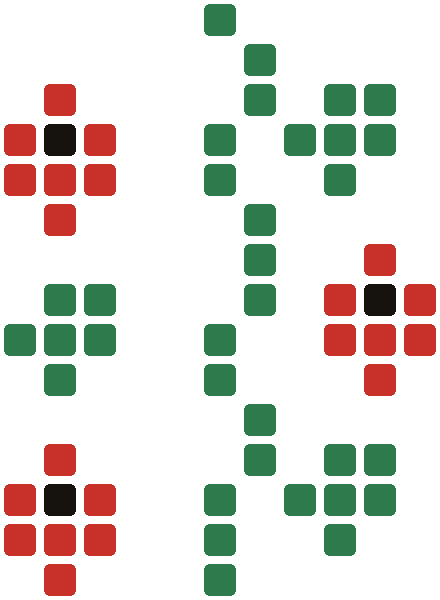
The typical scheme is a geometric female figure, usually frontal and symmetrical:
- arms raised — the so-called gesture of prayer;
- arms spread sideways or lowered, sometimes holding flowers or branches;
- a triangular or trapezoid skirt, often patterned;
- on either side — birds, small trees, horses with riders;
- sometimes the head is replaced by a diamond or a flower, and the figure nearly merges with a flowerpot.
That last variant gave rise to one theory: Kytova believed the figure with raised arms is often better read as a stylized flowerpot or tree of life. Selivachov also identifies a distinct type of figures “blended” with trees or flowers, which village women called, among other things, vazon (flowerpot) or panny. Another theory links the raised-arms gesture to the Orant, the image of the Virgin with arms lifted in prayer. These theories do not exclude each other.
Myths and modern interpretations
“Berehynia is a guardian goddess thousands of years old.” As shown above, this is a modern idea that spread in the 1980s. Old texts mention only berehyni in the plural, with no description.
“Berehynia is a symbol of Ukrainian matriarchy.” The idea of an ancient Ukrainian “matriarchy” finds no support in modern anthropology. Kis treats it as an ideological construction.
“Every female figure on a towel is a berehynia.” As far as the evidence shows, the women who stitched such towels in the 19th and early 20th centuries did not use the name. You can call the motif “berehynia” today, but it is a new name for an old ornament.
“The trident grew out of a Berehynia image.” This claim was spread by, for example, the writer Serhii Plachynda. He offered no evidence for it, and scholars do not support it.
Berehynia and the motanka doll. Modern workshops often call the motanka (a wrapped rag doll) the “berehynia of the family.” This, too, is a late transfer of the image.
The Independence Monument. The female figure atop the column on Kyiv’s Independence Square (2001) is often called Berehynia. Kis points to its resemblance to the Orant Virgin in St. Sophia’s Cathedral, while Selivachov sees the monument as the “apotheosis” of the word’s transformation: from a “demonic” being in old sermons to the protector of the native land.
The honest summary: the female figure is a real and fascinating motif of folk ornament whose meaning is not known for certain. “Berehynia,” as its name and as an ancient goddess, belongs to modern culture. For other motifs and ways of reading them, see our guide to Ukrainian embroidery symbols.
FAQ
Was Berehynia an ancient Slavic goddess?
There is no direct evidence of that. Old Rus’ sermons against paganism mention “berehyni” only in the plural, and their role is unknown. The image of a “goddess guarding the hearth” spread in the late 1980s.
Did embroiderers call the female figure on a towel a berehynia?
No. Art historian Mykhailo Selivachov writes that in his fieldwork of the 1970s–1990s the word “berehynia” was never recorded, and that it appears in art-historical literature only from the late 1960s. Towel researcher Svitlana Kytova reported the same.
So what does the female figure with raised arms depict?
There is no definite answer. Suggested readings include a stylized flowerpot or tree of life, an echo of the Christian Orant, and a distant echo of Neolithic goddess images. None has been conclusively proven.
Is it fine to embroider a “berehynia” if the image is modern?
Of course. The female figure on a towel is a genuine traditional motif, and the modern meanings people give it are part of a living culture. The only thing to avoid is presenting new interpretations as thousands of years old.