Hops
Hops is a plant motif of a twining stem with leaves and cones; in Ukrainian folk songs it stands for a young man, courtship and wedding merriment.
Hops, khmil in Ukrainian, is a plant motif in Ukrainian embroidery: a winding stem with leaves and cones that runs as a border along an edge or twines around other flowers. Scholars note it above all in the Kyiv and Chernihiv regions and in Polissia, the wooded north of Ukraine. The motif’s meaning is best explained by folklore: in folk songs, hops stand for a young man, courtship, revelry and wedding merriment.
Meaning and interpretations
The fullest account of hops in song symbolism comes from the 19th-century historian Mykola Kostomarov, in a study published in 1872. His observations are worth retelling in some detail, because they show how ambiguous the image was.
The word itself matters too. In Ukrainian, khmil means not only the plant but also intoxication — hence khmilnyi (tipsy) and pokhmillia (hangover). Hops have long been used in brewing, so their link with feasting and revelry in songs is entirely natural. That is also the source of the image’s double edge: hops bring joy, but also make a person reckless and fickle.
Courtship and fickleness. According to Kostomarov, hops in songs symbolize philandering, carousing and inconstancy. A mother asks her son, who has been out somewhere all night, where he slept, and compares him to hops. A young man going to see a girl while playing the kobza (a lute-like instrument) or a pipe is likewise compared to hops. In other songs hops are a frivolous lad whom a girl should not trust.
Being in love. At the same time, hops withered in the sun are a young man who has finally fallen in love and is pining away. Interestingly, Kostomarov notes that a girl is sometimes compared to hops as well — one who picked through suitors for a long time and ended up marrying a widower.
Weddings. In wedding songs, Kostomarov writes, hops symbolize feasting and merriment. He quotes lines along the lines of “spread, little hops, along the fence,” where the hops roll from the boundary to the gate and the musicians are urged to play in the yard.
Bravery. In Cossack songs hops were compared to a brave warrior. Kostomarov believed this is why the 17th-century hetman Bohdan Khmelnytskyi was often called simply Khmil in songs: his surname coincided with an existing symbol.
It is important to understand what kind of evidence this is. Kostomarov drew on printed song collections, on songs he recorded himself in the late 1830s and early 1840s, and on recordings passed to him by other collectors. So these are meanings of hops in songs, not explanations of embroidery. On top of that, 19th-century readings of symbols often had a romantic coloring, so they too should be read critically.
Modern popular lists class hops among “masculine” symbols, alongside the oak, the sycamore and the grapevine, and say that in wedding songs hops personify the groom and the couple’s strong love. This fits the folklore but does not rest on specific records, so treat it as a generalization.
Did embroiderers carry the song meaning over to ornament? We found no direct evidence. It is quite possible that “hops” on a shirt or rushnyk (ritual towel) was first of all a beautiful twining border, and that associations with youth and weddings arose naturally because everyone knew these songs.
Where it appears
Kyiv region. Art historian Tetiana Kara-Vasylieva lists bunches of grapes and hops, sprigs with berries and small red stars outlined in black among the common motifs of the Kyiv region.
Polissia and the Chernihiv region. She also names hops together with roses, periwinkle, bindweed and “goose feet” among the motifs of the Kyiv and Chernihiv regions and Polissia.
Borders. Art historians Oleksandr Naiden and Mykhailo Selivachov mention khmelyk (“little hops”) among the names of border patterns, next to bihunets (“runner”). That explains the shape well: hops climb and twine, which makes them convenient for edging a hem, a sleeve or the end of a towel.
For the most part, hops are an embroidery motif.
How it is depicted
The main ways of rendering hops in embroidery:
| Variant | What it looks like | Where it is placed |
|---|---|---|
| Khmelyk border | a wavy or zigzag line with leaves and cones on both sides | hem, cuffs, collar, towel edges |
| Upright branch | a stem twining upward with leaves and cones | shirt sleeve, towel ends |
| Hops in a bouquet | a hop vine wound around another flower or cluster | plant compositions on towels |
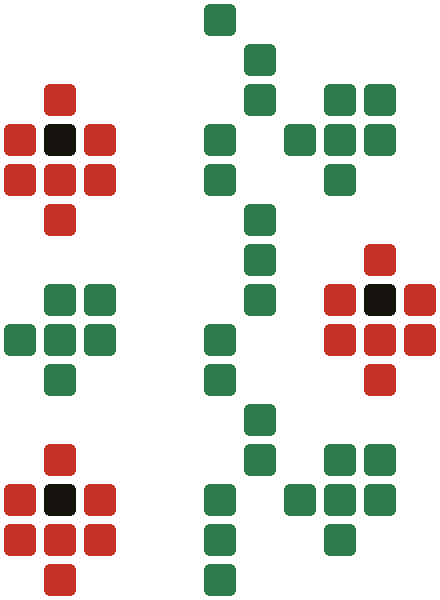
Hop cones are usually stitched as small diamonds or clusters, and the leaves as three-lobed or diamond shapes. In geometric embroidery hops are easily confused with grapevine: both plants climb and bear clusters, and both motifs were common in the Kyiv region.
If you want to embroider hops today, look at specific museum pieces from the region you care about rather than at “universal” charts from the internet. That is where you can see how local makers built the stem, how large they made the cones and which motifs they paired with hops.
Colors follow local tradition: red and black, green and red, and so on. Our illustration shows a green winding stem with leaves and red cones with black centers.
Myths and modern interpretations
“Hops protect against infidelity.” This explanation turns up on “symbol meaning” websites, but ethnographic works do not confirm it. What is more, in songs recorded in the 19th century hops often stand for precisely the fickle suitor.
“Hops symbolize the strength of the family line and the endlessness of life.” Phrases like this are a modern generalization. The motif is indeed linked to youth and weddings, but a “family line” symbolism cannot be traced in the old records.
“Hops on a shirt attract love.” This is a free extension of the song symbolism. As a wish it fits the spirit of the tradition well; as a “magic rule” it is modern.
Showering the bride with hops. Popular texts sometimes say the bride was showered with hops before the church wedding. We found no reliable confirmation of this custom, so we do not claim it was widespread.
To sum up: hops are a lively, “merry” motif whose symbolism is documented above all in songs. They stood for youth, courtship, weddings and revelry — with an ambiguity that modern “amulet dictionaries” tend to lose. A related plant motif is the ruzha (rose), and a general overview is in our guide to Ukrainian embroidery symbols.
FAQ
What do hops symbolize in Ukrainian embroidery?
We found no direct explanations from embroiderers of the past. The surest meaning comes from folklore: in songs hops stand for a young man, courtship and wedding merriment, so the motif is usually read as a sign of youth and love.
Are hops a “masculine” symbol?
In songs hops do more often personify a young man, and modern lists group them with “masculine” symbols. But Kostomarov also cites songs that compare a girl to hops, so there is no strict division.
How can you tell hops from grapevine in embroidery?
In stylized ornament it can be hard. Hops usually have a twining stem and cone-like clusters, while grapevine has bunches of round berries. Scholars list bunches of grapes and hops side by side among the common motifs of the Kyiv region.
Is it true that hops protect against infidelity?
Such claims appear in popular texts, but ethnographic records do not confirm them. In fact, in old songs hops often stand for exactly the fickle suitor.