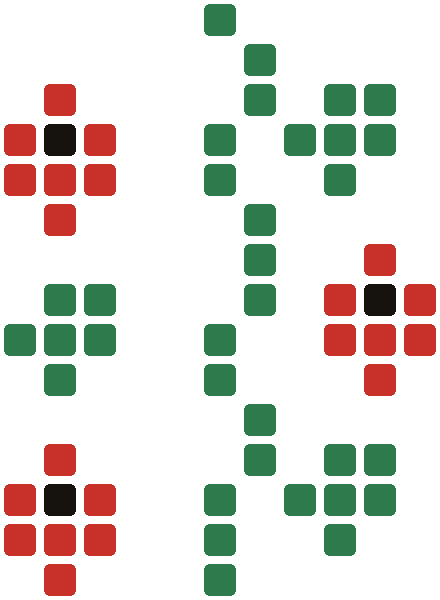
Kalyna
A plant motif of red berry clusters and leaves; in folklore one of the central images, linked above all with a young woman, love and weddings.
Kalyna, known in English as guelder rose or viburnum (Viburnum opulus), is perhaps the most “sung-about” plant in Ukrainian culture. Its image runs through lyrical, wedding, funeral, historical and soldiers’ songs, and in the decorative arts through embroidery and painting. Yet the folklore symbol and the ornamental motif have different histories, and it is worth keeping them apart.
Meaning and interpretations
Folklore. The most deeply documented meaning of kalyna lies in folk poetry. As early as the 19th century, the folklorists Mykola Kostomarov, Oleksandr Potebnia and others analyzed the image of kalyna in songs and concluded that it is most often linked with a young woman: her beauty, youth and fate. In 1872 Kostomarov called kalyna a symbol of femininity in the broad sense, from maidenhood and love to married life with its joys and sorrows. He stressed that, unlike the rose, kalyna is never compared to a young man in the songs. Kalyna is also a common image of love and parting, while “kalyna on a grave” is an image of remembering the fallen.
Weddings. Kalyna is often described as a “wedding tree”: its branches decorated tables, the korovai (wedding bread), maidens’ wreaths and gifts. How obligatory this custom was probably varied by region, so the claim “there was no wedding without kalyna” is best taken as a generalization.
A historical and national symbol. The red berries were compared to drops of blood, and in the songs of the Ukrainian Sich Riflemen and later insurgent fighters, kalyna became an image of courage and sacrifice. The key role here belongs to the song “Oi u luzi chervona kalyna” (“Oh, in the meadow, a red kalyna”). Its folk version was printed in 1875 in a collection of Ukrainian historical songs by Volodymyr Antonovych and Mykhailo Drahomanov, who connected it with the events of 1648. The riflemen’s version of 1914 is associated with Stepan Charnetskyi, who most likely reworked an older folk song. In the USSR the song was banned and suppressed; after Ukraine regained independence it became one of the national symbols, and many readers abroad will know it from 2022.
Tales and legends. Kalyna is the heroine of many folk tales. The best known are “The Kalyna Pipe,” in which a shepherd’s pipe cut from a bush that grew on the grave of a murdered sister tells the truth about the crime, and “The Kalyna Bridge.” These stories show that in folklore kalyna is tied not only to joy but also to death, memory and justice.
Ornament. Unlike folklore, the ornamental kalyna motif has far fewer field records of embroiderers explaining it. Meanings of embroidered kalyna are usually “carried over” from songs. That is logical, but it is worth being aware of the transfer.
Where it appears
Embroidery. Kalyna is counted among the main plant motifs of Ukrainian embroidery, together with grapevine, oak, rose, lily, poppy and hops. Naturalistic branches with red clusters and green leaves spread especially in the late 19th and early 20th centuries, when factory-made thread and dyes appeared and embroidery became multicolored and closer to its natural models. Today kalyna is one of the most popular motifs on the vyshyvanka (embroidered shirt) and the rushnyk (ritual towel), especially in cross-stitch. Our guide to Ukrainian embroidery symbols puts it in context with other motifs.
Petrykivka painting. Kalyna berries are a familiar element of Petrykivka decorative painting; painters often “print” them with a fingertip to get even, round marks. This trick is handy for beginners.
Ritual objects. Fresh kalyna branches were used above all in wedding decoration: for wreaths, the wedding bread and the festive table.
Modern art and symbolism. Since the early 20th century, and especially after 2014 and 2022, kalyna has become one of the most widely used national images. It is embroidered on contemporary shirts, painted on greeting cards and used in emblems. This is a living tradition, but it should be distinguished from the ethnographic one: modern compositions often mix motifs from different regions and periods.
How it is depicted
| Variant | What it looks like | Where it is more common |
|---|---|---|
| Cluster in cross-stitch | A round or triangular group of separate red “berries” | Cross-stitch |
| Branch with leaves | A curved branch with several clusters and three-lobed leaves | Shirts, towels, tablecloths |
| Kalyna with oak | Kalyna clusters combined with oak leaves and acorns | Embroidery, cards, modern decor |
| Fingerprint berries | Groups of even red dots | Petrykivka painting |
The kalyna leaf has a distinctive three-lobed shape, the main feature that tells it apart from the grapevine or hops. Berries are stitched in red (sometimes with a dark highlight dot), leaves in green, stems in black or brown.
Colors
The motif’s main color is red: “red kalyna,” chervona kalyna, became a fixed poetic image. In 20th-century embroidery kalyna is usually worked in three colors: red for berries, green for leaves, black or dark brown for branches. In older monochrome embroidery, for example all-red or all-black work, plant motifs that people now recognize as kalyna could have no “plant” color at all, and then only local tradition determines the motif’s name.
Keep in mind that popular “color meaning charts” (red for love and life, green for spring and youth, and so on) are modern generalizations. They are handy as a hint, but they were not a rule that every embroiderer followed.
Myths and modern interpretations
- “Kalyna comes from the word kolo, meaning the sun; it is a symbol of the birth of the universe.” This “folk etymology” is very common in popular texts. Linguists, however, derive Proto-Slavic kalina from *kalъ, “wet ground, marsh, mud,” because the shrub tends to grow in damp places. Cosmological readings of kalyna are modern.
- “Kalyna is the oldest protective charm of the clan.” Its protective meaning is often emphasized today, but in the classic folklore studies other things come first: a young woman’s beauty, love, fate.
- “Embroidered kalyna is an ancient Trypillian sign.” There is no basis for this. The image in folklore is old, but realistic embroidered kalyna in its present form belongs mostly to the 20th century.
Folklorists use the word “fakelore” for modern inventions passed off as folk tradition. Kalyna needs no invented “thousand-year-old” meanings: its real history in songs and rituals is rich enough. You can compare it with other plant motifs, such as the tree of life and the ruzha (rose), in our symbols encyclopedia.
FAQ
What does kalyna symbolize in Ukrainian culture?
19th-century folklorists (Kostomarov, Potebnia and others) most often linked kalyna in folk songs with the image of a young woman; Kostomarov called it a symbol of femininity in the broad sense. Kalyna is also a wedding plant and an image of love, longing and remembrance, and since the 20th century a national symbol as well.
Is the kalyna motif in embroidery ancient?
The image of kalyna in folklore is old, but realistic kalyna branches in red and green cross-stitch are mostly a phenomenon of the late 19th and 20th centuries, when factory-made thread and printed patterns spread.
Where does the word kalyna come from?
The word is inherited from Proto-Slavic. Linguists connect it with Proto-Slavic *kalъ, "wet ground, marsh, mud," after the damp places where the shrub grows. They find versions deriving the name from the berries' color unconvincing, and the popular "kalyna comes from kolo, the sun" has no scholarly basis.
How did the song "Oi u luzi chervona kalyna" become a symbol?
A folk version of the song was published as early as 1875 in a collection by Antonovych and Drahomanov; the riflemen's adaptation is associated with Stepan Charnetskyi (1914). In Soviet times the song was banned and suppressed, and after 1991 it became one of Ukraine's national symbols.