Eight-pointed star
The eight-pointed (eight-rayed) star is one of the most common geometric motifs in Ukrainian embroidery, weaving and pysanky.
The eight-pointed star, known in Ukrainian as vosmyrozhka, is a figure of eight diamonds or “petals” radiating from a center. It is one of the most common geometric motifs in Ukrainian embroidery, weaving and pysanky (wax-resist Easter eggs). It has no single “correct” meaning: ethnographers have recorded several folk names and several interpretations, and some of the explanations you will find online today are quite recent.
Meaning and interpretations
Start with the name. Vosmyrozhka is widely used in modern popular books and among embroiderers, but specialist ethnographic and art-historical writing usually avoids it. There the motif is described plainly as an “eight-pointed star,” an “eight-rayed star,” or a rozha (rose). The Volhynian ornament researcher Nataliia Bendiuk also mentions local names such as zvizdy (stars) and vitriak (windmill).
The most widespread reading is solar. Pysanka researchers, among them Marusia Chaika, see the large eight-rayed rose on the side of an egg as a sign of the sun. This is a scholars’ interpretation, not an explanation recorded from the women who made the eggs. When many small stars cover the whole surface, the same reading treats them simply as stars in the sky.
A second reading follows from the name “rose.” Art historians Oleksandr Naiden and Mykhailo Selivachov note that a rosette of eight diamonds was known in folk usage as the “full rose” (povna rozha) and associated with maidenhood. They also stress that ornament carries associative, layered meanings: the same system of diamonds can be read as the sun, as a sown field, or as a sign of fertility.
It is worth knowing the limits of all this. These interpretations rest on motif names, folklore parallels and comparisons with other cultures. Few direct explanations from 19th-century embroiderers survive, and for many of them the star was above all a beautiful, “proper” figure handed down from mother to daughter.
Field interviews from central Polissia, the wooded region of northern Ukraine, published in 2022, illustrate the point. Most of the women interviewed said that the sun, moon and stars were not embroidered in the old days; one explained that “that is holy.” Yet art historians list eight-pointed stars among the main motifs of Polissian embroidery. The simplest explanation: what we call a “star” today may have been, for the embroiderer, just a pattern, a diamond or a flower.
For a broader introduction to reading Ukrainian ornament, see our guide to Ukrainian embroidery symbols.
Where it appears
Embroidery. Art historian Tetiana Kara-Vasylieva observed that in Polissia whole compositions were built from diamonds, eight-pointed stars and zigzag lines. For the Kyiv region she mentions red stars outlined in black, and for the Middle Dnipro region a motif called zori (stars).
Weaving. Bendiuk and her colleague O. Nykorak describe Volhynian bedspreads and pillowcases decorated with eight-pointed “Volhynian stars.” Eight-rayed stars also appear on woven rushnyky (ritual towels).
Pysanky. Bendiuk calls the eight-pointed star one of the most important elements of Volhynian egg decorating. Large “roses” usually sit in the center of each side of the egg; small ones run in bands or scatter across the whole surface.
Beyond village art. The star also appears in church ornament — for example, in the background of a 17th- or 18th-century Nativity icon held in a museum in Ostroh. Bendiuk also points out that the eight-pointed form became the basis of the Christmas stars carried by carolers almost everywhere in Ukraine except Galicia, where stars more often had an odd number of rays.
In short, the motif is not tied to any one region, so we do not list one.
How it is depicted
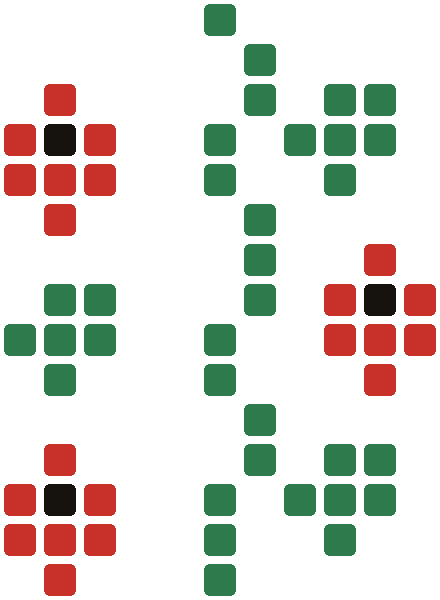
In cross-stitch the star is most often made of eight diamonds meeting at the center. Sometimes it is built differently: an upright cross laid over a diagonal one, or two squares rotated 45 degrees against each other. Our illustration shows the diamond version with a black heart.
The main variants:
| Variant | What it looks like | Where it appears |
|---|---|---|
| Full star (rose) | filled rays, a square or diamond of another color in the center | towels, shirts, pysanky |
| Empty (outline) star | outline only, hollow middle | embroidery, weaving |
| Star in a rosette | star set inside a circle or octagon, sometimes a “rose within a rose” | pysanky |
| Border of stars | small stars repeated in a band | shirts, towels |
The names “starry rose,” “full rose” and “empty rose” were recorded by Iryna Hurhula, who studied pysanky from the collection of the National Museum in Lviv in 1929. They were used in Galician Volhynia, around Sokal, Belz and Brody. Bendiuk explains “full” and “empty” as the difference between a filled and an outlined figure — her suggestion, not an explanation recorded from the makers.
The classic color pair is red and black, but other combinations occur, including single-color stars. On pysanky, yellow, red and black are common. If you are new to cross-stitch, the eight-pointed star is a good first motif: it is symmetrical, easy to count and looks striking even in one color.
Myths and modern interpretations
A lot of later layers have built up around this star. They are worth separating from what ethnographers actually documented.
“Alatyr,” “Svarog’s cross,” “the star of Ruzha.” Popular articles and online amulet shops often call the eight-pointed star “Alatyr” or link it to “Slavic gods.” No such folk names for the embroidered star appear in ethnographic records. These names come from modern neopagan and esoteric literature and should be treated as present-day interpretation, not tradition.
“The union of masculine and feminine.” One explanation says the upright cross is the masculine (solar) principle, the diagonal cross the feminine (lunar) one, and together they form a “union of man and woman.” It even turns up in library reading lists. This is a modern author’s interpretation, promoted among others by Yu. Melnychuk; we found no field records that support it.
“An amulet that protects against all evil.” Ethnographers do record a belief in the protective power of embroidery, but it concerned the object as a whole — a shirt, a towel — not a particular geometric figure with a “guaranteed” effect. Claims such as “a star on the collar protects the throat” are modern.
“An unchanged symbol thousands of years old.” Diamond-based ornaments are indeed very old, but that does not mean a fixed meaning was passed down unchanged for millennia. Folk ornament was alive: it borrowed motifs from church and town art and lent its own in return.
The most honest answer to “what does the eight-pointed star mean?” is this: it is an old and very widespread motif that village women called a star or a rose. Scholars read it as a solar sign or as a flower linked with a girl’s beauty; most other meanings are modern. A closely related motif is described on the ruzha (rose) page, and the full list is in our symbol encyclopedia.
FAQ
Is the eight-pointed star the ancient Slavic “Alatyr”?
No such name for the embroidered star appears in ethnographic records. Names like “Alatyr” or “Svarog’s cross” come from modern esoteric and neopagan writing.
How is the eight-pointed star different from the ruzha (rose) motif?
Often it isn’t: on pysanky and towels the same eight-petaled figure is called both a star and a rose. Pysanka researchers distinguish, at most, “star” versions built on a square from “flower” versions built on a circle.
What does the eight-pointed star mean?
There is no single meaning. Researchers most often mention a solar reading, and art historians link the “full rose” of eight diamonds with maidenhood. Embroiderers themselves mostly named the motif by its shape, without explanation.
Can a man wear an eight-pointed star?
We found no evidence that the motif was strictly female or strictly male. Eight-pointed stars appear on shirts, ritual towels, pillowcases, woven bedspreads and pysanky.