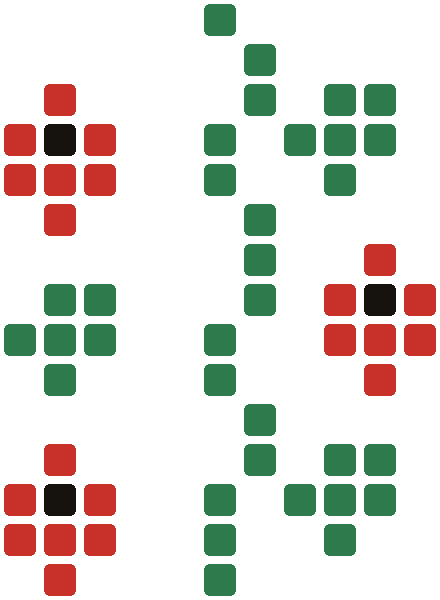
Rooster
The rooster, a bird whose crowing "measured out" the night and announced dawn; one of the most recognizable animal motifs in Ukrainian folk art.
The rooster (pivni means “roosters” in Ukrainian; the affectionate pivnyk is “little rooster”) is probably the most popular bird in Ukrainian folk art. It is embroidered on the rushnyk (ritual towel) and on shirts, painted in Petrykivka decorative painting, modeled in clay as a whistle, and occasionally drawn on pysanky (wax-resist Easter eggs). Part of its popularity is simply practical: it is a familiar, bright, “decorative” bird. Part goes back to old beliefs about the rooster as the herald of dawn.
Meaning and interpretations
Folk beliefs. The best-documented layer is the set of beliefs around the rooster’s crow. Before clocks were common in villages, people told the time at night by the “first,” “second” and “third” roosters, roughly at ten in the evening, at midnight and at two in the morning. The crowing was thought to mark the edge of the night hours, when “devilish” forces were active. From this come expressions like “until the first roosters” and the idea of the rooster as a guard against night terrors.
A solar bird. Researchers of pysanky count the rooster among solar symbols precisely because it greets the sunrise. In their reading, the parts of the bird on an Easter egg, such as the comb, beak, feet or feathers, carry the same meaning as the whole bird.
Fertility and the household. Researchers of pysanky read hens, ducks and geese as symbols of fertility. The rooster, as “master” of the henhouse, fits that circle, although field records that describe the ornamental rooster specifically as a wish for wealth are few.
A Christian layer. The Gospel story of the apostle Peter denying Christ three times before the rooster crowed made the bird an image of vigilance and repentance in Christian culture. Roosters on spires and weathervanes have long been known across Europe; how far that tradition shaped folk ornament is hard to say.
Where it appears
Petrykivka painting. Here the rooster is one of the best-known characters: bright, with a lush multicolored tail. When Petrykivka decorative painting was inscribed on UNESCO’s Representative List of the Intangible Cultural Heritage in 2013, roosters and birds were named among its motifs. The bearers of the tradition also explain what they put into the motif today: the rooster stands for fire and spiritual awakening, birds for light, harmony and happiness.
Embroidery and towels. Birds are a common animal motif in embroidery, and roosters are among them. One example is a homespun linen towel from the village of Obych, now in a local history museum in Kremenets, western Ukraine: its black-and-red cross-stitch ornament combines plant motifs with stylized birds and roosters. There are no precise data on how often roosters came in pairs or when such towels were most widespread. For more on reading embroidery, see our guide to Ukrainian embroidery symbols.
Pysanky. A whole rooster is drawn on Easter eggs less often than its “parts” or other birds. On Hutsul pysanky from the Carpathians, poultry was sometimes shown in full.
Clay toys. Rooster whistles, svyshchyky, are a classic subject of folk ceramics. One example, kept in the same Kremenets museum, is a brown clay rooster whistle on a green base, about 8 cm (3 in) tall, made by the potter Hryhorii Dziuma from Vyshnivets.
How it is depicted
| Variant | Features | Where it is more common |
|---|---|---|
| Single rooster in profile | Comb, wattles, raised tail, clearly marked feet | Cross-stitch, Petrykivka |
| Pair of roosters | Two birds mirrored on either side of a flowerpot, flower or tree | Towels, pillowcases, tablecloths |
| Rooster with a flower or branch | A bird among plant ornament, often with a flower near its beak | Petrykivka painting |
| Parts of the bird | Combs, “hen’s” or “goose” feet, feathers | Pysanky |
| Three-dimensional figure | A whistle or toy decorated with glaze or slip | Pottery |
The color scheme depends on the technique. In cross-stitch the rooster is most often worked in red and black, sometimes with a multicolored tail. In Petrykivka it is usually polychrome, with contrasting red, yellow and green feathers. On pysanky it uses the same limited palette as the rest of the design.
Three features set the rooster apart from other birds in ornament: the comb, the wattles and a high, often split tail. A hen is drawn without the lush tail and comb, a peacock with a long trailing tail, a dove with a smooth head. In stylized patterns these lines blur, and then the motif’s name is best taken from local tradition.
A mirrored pair of birds on either side of a central axis is an old and very widespread device in ornament generally. It is also linked to the tree of life, where birds perch on the branches.
Myths and modern interpretations
Many modern explanations have grown up around the rooster and are often presented as “ancient”:
- “A pair of roosters means the bride and groom, so they are embroidered only on wedding towels.” Paired birds do appear on wedding towels, but just as much on ordinary decorative ones. Ethnographic records do not show any such strict rule.
- “The rooster is the sacred bird of Perun (or another god).” Such claims are common in popular books, but there is no direct evidence linking the ornamental rooster to a particular pagan deity. The art historian Mykhailo Selivachov stressed that none of the folk names of ornamental motifs derives from the name of a pagan god, the only exception being the late term berehynia (see Berehynia).
- “A towel with roosters is an obligatory protective charm for the home.” The rooster’s protective sense has a basis in beliefs about its night crowing, but turning every embroidered rooster into a “charm” is more a feature of modern popularization.
- “In Petrykivka the rooster means fire and awakening.” This is genuinely how today’s Petrykivka painters explain it, and their view deserves respect. At the same time, it is the community’s interpretation, not something recorded by ethnographers of the past.
In short, the rooster is a favorite character of folk art, connected to folk beliefs about dawn and the limits of the night. Other meanings are best presented with the note “according to a modern interpretation.”
See also: Ruzha (rose), Deer.
FAQ
What does the rooster symbolize in Ukrainian tradition?
In folk belief the rooster is tied to dawn and to the boundaries of the night: its crowing marked the limits of the nighttime hours when, people believed, evil forces were active. Hence the reading of the rooster as a solar and protective image. Other meanings, such as fertility, prosperity or weddings, appear more often in modern interpretations.
Why are two roosters often embroidered on ritual towels?
A pair of birds on either side of a tree, flowerpot or flower is a common mirror composition in Ukrainian ornament, and roosters are one version of it. The popular explanation that "two roosters are the bride and groom" is a modern interpretation, not an established ethnographic fact.
What does the rooster mean in Petrykivka painting?
When Petrykivka painting was inscribed on the UNESCO intangible heritage list in 2013, the bearers of the tradition described the rooster as a symbol of fire and spiritual awakening, and birds in general as light, harmony and happiness. This is how today's community of practitioners puts it.
What is the "red rooster"?
It is a set expression meaning "fire"; to "let loose the red rooster" meant to set something ablaze. It has no direct connection to the ornamental motif.